Frequently asked questions
Which size should I choose?
This work is available in 30 × 40 cm. As a guide: 30 × 40 cm (about 12 × 16 in) for shelves, corners or gallery walls; 50 × 70 cm (about 20 × 28 in) above a dresser, a headboard or a desk; 70 × 100 cm (about 28 × 39 in) as the centrepiece of a living room or the wall above the sofa. Below the buy buttons you can see it to scale above a 2-metre sofa.
Does it come framed?
The print arrives unframed with a white border, ready to frame. If you choose a black or oak frame, it arrives mounted behind acrylic glazing, ready to hang. Canvases come stretched on a wooden frame.
When will it arrive?
Printed to order at the lab closest to your address. It arrives in 4–8 working days in Spain and the EU, and in 6–12 working days in the US, Mexico and other destinations.
What if it arrives damaged?
Email us a photo within 30 days of delivery and we will send you a new one free of charge or refund you.
Can I send it as a gift?
Yes. At checkout you can write a gift message and ship it to the recipient's name and address. The parcel shows no prices.
About the work
- Artist
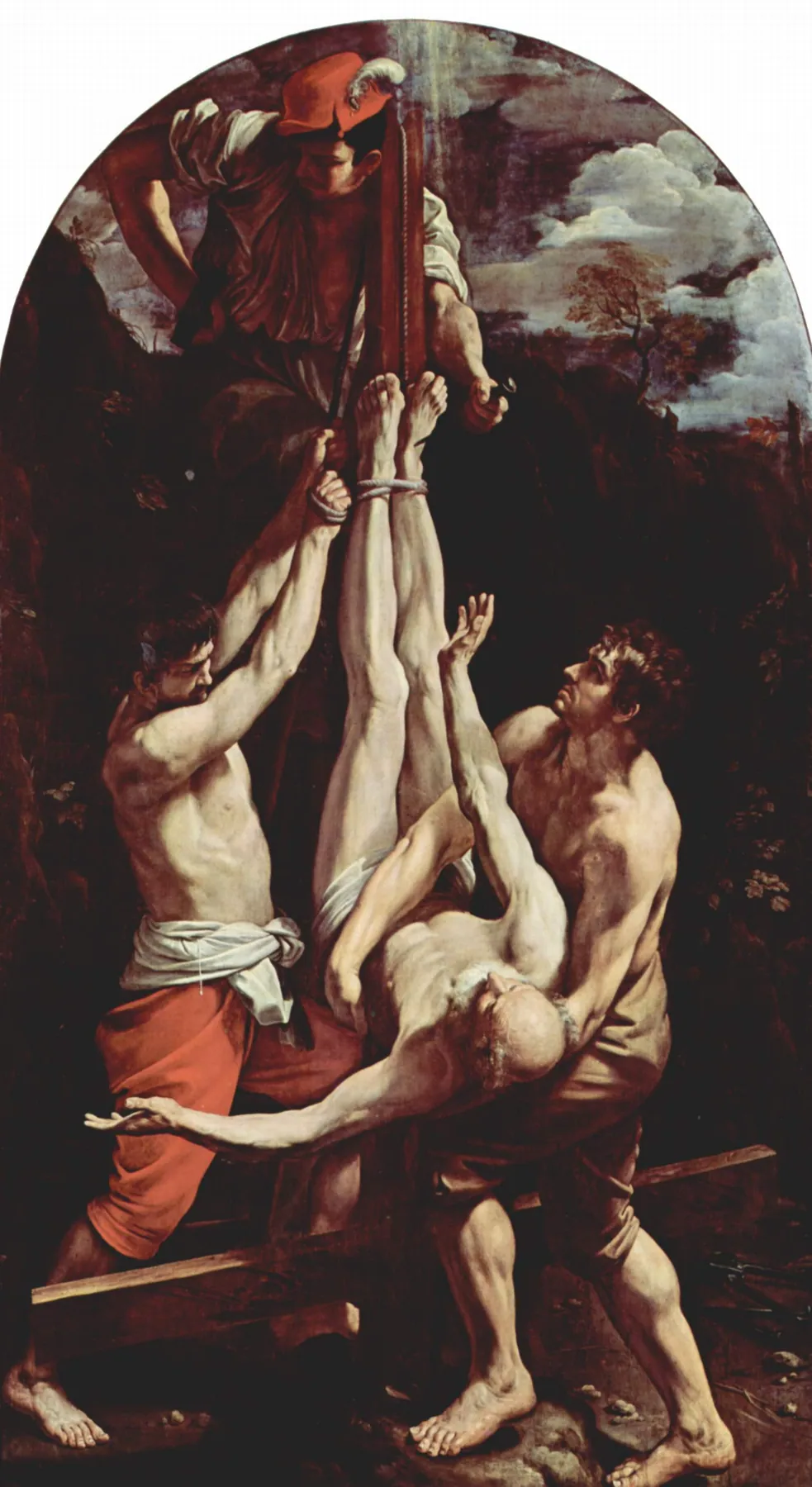
- Guido Reni
- Date
- 1604
- Medium
- Oil on panel (altarpiece on panel)
- Collection
- Pinacoteca Vaticana (Vatican Museums)
- Print up to
- 30 × 40 cm
- Reference
- XDV-1920
What the museum label doesn't tell you
Peter isn't hanging, he's sinking. His bald head nearly touches the ground, feet bound and raised, the whole body twisted into a diagonal that seems to struggle against its own execution. The man in the red cap straddles the crossbar, hauling the rope with the flat calm of someone finishing a chore, not committing a crime. Guido Reni painted this around 1604-05 for a specific altar, under a specific light, in San Paolo alle Tre Fontane. The French took it in 1797, and when it came back nobody sent it home: it now hangs in the Vatican, while the original altar holds only a copy. The saint was never set right side up again, and neither was the painting. Historical coincidence, or does history paint its own irony?