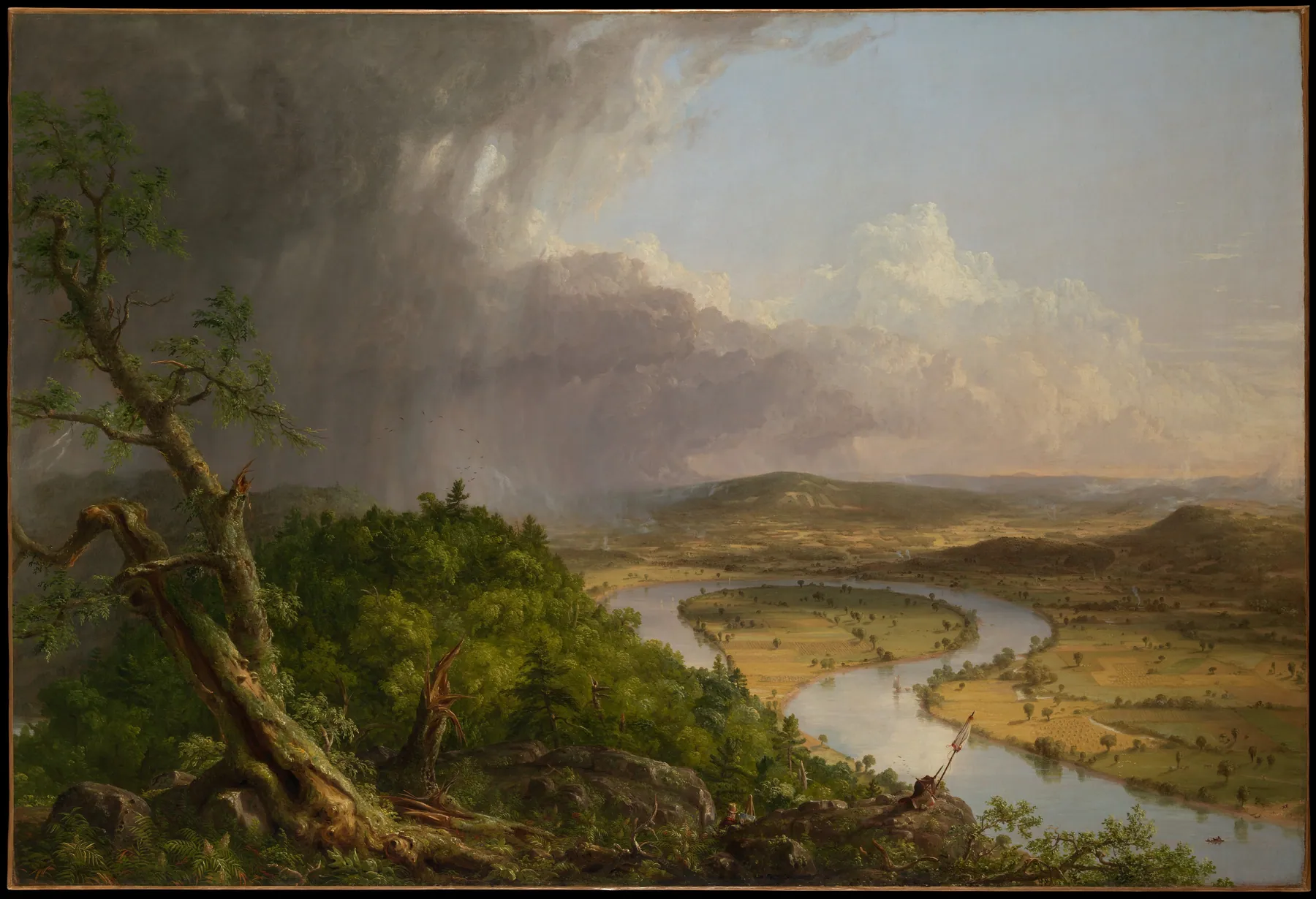
View from Mount Holyoke, Northampton, Massachusetts, after a Thunderstorm—The Oxbow
Thomas Cole, 1836
From €29Museum-quality print, also on canvas and framed.
Frequently asked questions
Which size should I choose?
This work is available in 30 × 40 cm, 50 × 70 cm. As a guide: 30 × 40 cm (about 12 × 16 in) for shelves, corners or gallery walls; 50 × 70 cm (about 20 × 28 in) above a dresser, a headboard or a desk; 70 × 100 cm (about 28 × 39 in) as the centrepiece of a living room or the wall above the sofa. Below the buy buttons you can see it to scale above a 2-metre sofa.
Does it come framed?
The print arrives unframed with a white border, ready to frame. If you choose a black or oak frame, it arrives mounted behind acrylic glazing, ready to hang. Canvases come stretched on a wooden frame.
When will it arrive?
Printed to order at the lab closest to your address. It arrives in 4–8 working days in Spain and the EU, and in 6–12 working days in the US, Mexico and other destinations.
What if it arrives damaged?
Email us a photo within 30 days of delivery and we will send you a new one free of charge or refund you.
Can I send it as a gift?
Yes. At checkout you can write a gift message and ship it to the recipient's name and address. The parcel shows no prices.
About the work
- Artist
- Thomas Cole
- Date
- 1836
- Medium
- Oil on canvas
- Dimensions
- 130,8 x 193 cm (51 1/2 x 76 in.)
- Collection
- The Metropolitan Museum of Art, New York
- Print up to
- 50 × 70 cm
- Reference
- XDV-4004
What the museum label doesn't tell you
This panorama is a fake: Cole stitched together two different views from Mount Holyoke to line up the storm perfectly against the sunlit farmland below. On the left, wild nature, dark and gnarled; on the right, cultivated land, golden and still. And there, tiny among the rocks, the painter himself sits with easel and parasol, staring straight out at us, as if daring us to pick a side. Painted in 1836 alongside his Course of Empire series, the picture quietly records what made that tamed landscape possible: cleared forests and displaced Native communities under the Indian Removal Act. Which side would you choose from up there?