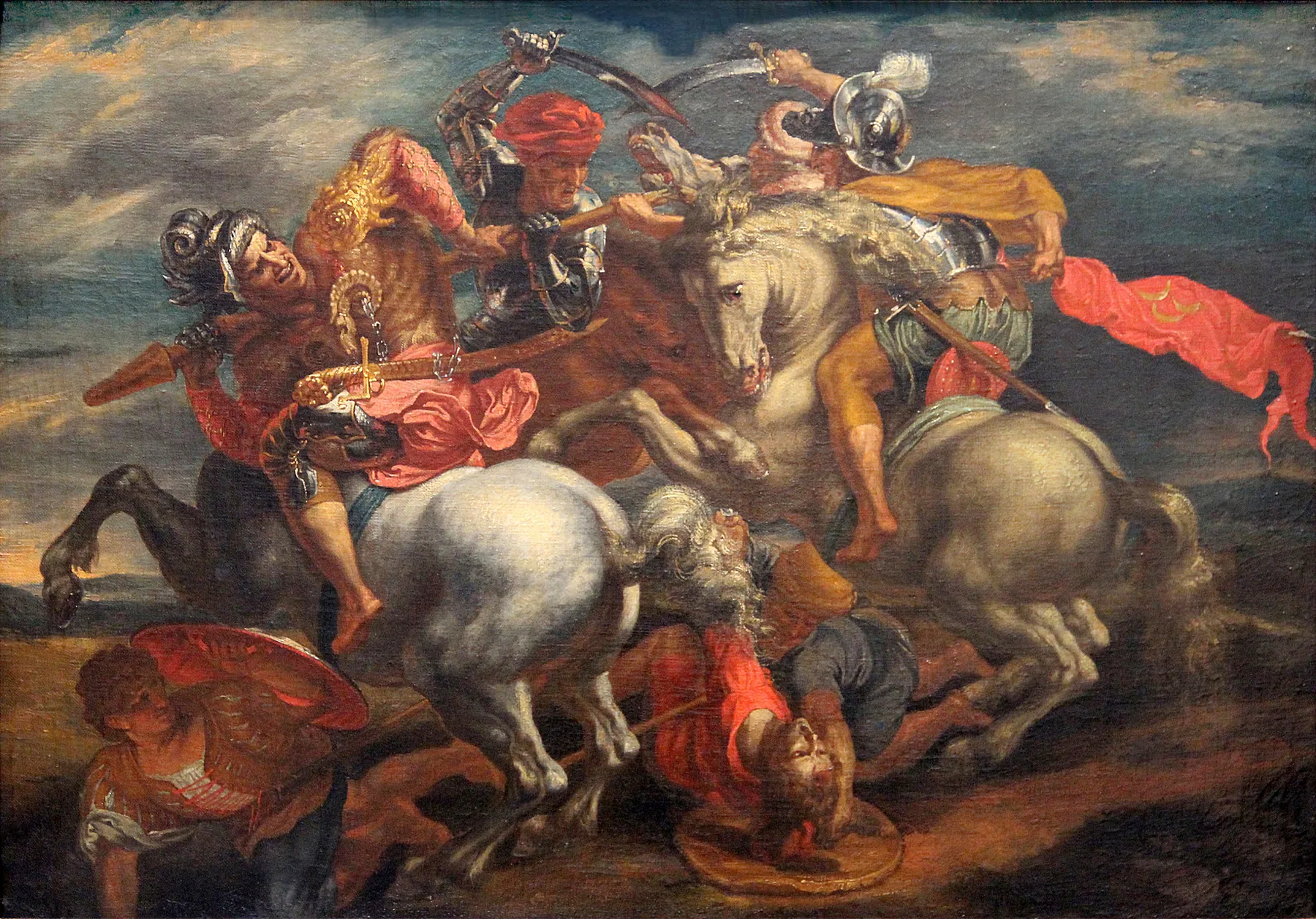
The Battle of Anghiari (Copy by Rubens)
Leonardo da Vinci, 1505
From €29Museum-quality print, also on canvas and framed.
Frequently asked questions
Which size should I choose?
This work is available in 30 × 40 cm, 50 × 70 cm. As a guide: 30 × 40 cm (about 12 × 16 in) for shelves, corners or gallery walls; 50 × 70 cm (about 20 × 28 in) above a dresser, a headboard or a desk; 70 × 100 cm (about 28 × 39 in) as the centrepiece of a living room or the wall above the sofa. Below the buy buttons you can see it to scale above a 2-metre sofa.
Does it come framed?
The print arrives unframed with a white border, ready to frame. If you choose a black or oak frame, it arrives mounted behind acrylic glazing, ready to hang. Canvases come stretched on a wooden frame.
When will it arrive?
Printed to order at the lab closest to your address. It arrives in 4–8 working days in Spain and the EU, and in 6–12 working days in the US, Mexico and other destinations.
What if it arrives damaged?
Email us a photo within 30 days of delivery and we will send you a new one free of charge or refund you.
Can I send it as a gift?
Yes. At checkout you can write a gift message and ship it to the recipient's name and address. The parcel shows no prices.
About the work
- Artist
- Leonardo da Vinci
- Date
- 1505
- Medium
- Black chalk, pen and brown ink, brush and brown and grey ink, grey wash, heightened with white and blue-grey, on a sheet extended with four lateral strips
- Dimensions
- Hoja original: 42,8 x 57,7 cm; hoja ampliada: 45,3 x 63,6 cm
- Collection
- Musée du Louvre, Paris (Département des Arts Graphiques)
- Print up to
- 50 × 70 cm
- Reference
- XDV-3028
What the museum label doesn't tell you
Look at that knot of bodies and horses: four riders, crossed sabers, a skull on the ground. Nobody actually knows what this scene looked like. Leonardo's fresco was gone by 1560. What survives is an anonymous Italian's copy of the lost preparatory cartoon, which Rubens bought without ever seeing the original and reworked with ink, wash, and extra paper strips to enlarge it. Three hands, a century apart, zero original. Dalí later copied this copy of a copy. The fury you're seeing belongs to Rubens, not Leonardo. How much of what we call a masterpiece is just the best surviving echo?