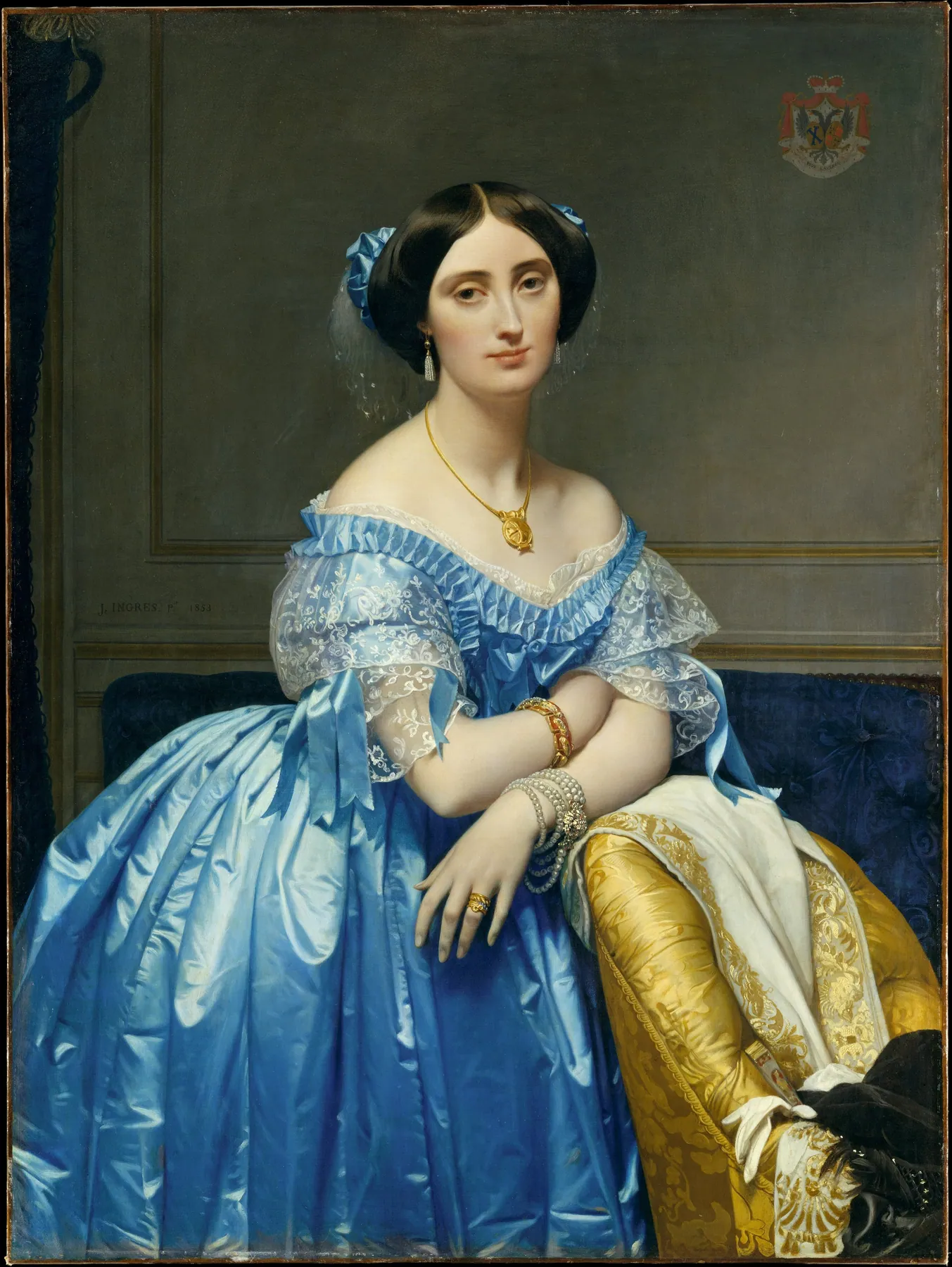
Princesse de Broglie
Jean-Auguste-Dominique Ingres, 1853
From €29Museum-quality print, also on canvas and framed.
Frequently asked questions
Which size should I choose?
This work is available in 30 × 40 cm, 50 × 70 cm. As a guide: 30 × 40 cm (about 12 × 16 in) for shelves, corners or gallery walls; 50 × 70 cm (about 20 × 28 in) above a dresser, a headboard or a desk; 70 × 100 cm (about 28 × 39 in) as the centrepiece of a living room or the wall above the sofa. Below the buy buttons you can see it to scale above a 2-metre sofa.
Does it come framed?
The print arrives unframed with a white border, ready to frame. If you choose a black or oak frame, it arrives mounted behind acrylic glazing, ready to hang. Canvases come stretched on a wooden frame.
When will it arrive?
Printed to order at the lab closest to your address. It arrives in 4–8 working days in Spain and the EU, and in 6–12 working days in the US, Mexico and other destinations.
What if it arrives damaged?
Email us a photo within 30 days of delivery and we will send you a new one free of charge or refund you.
Can I send it as a gift?
Yes. At checkout you can write a gift message and ship it to the recipient's name and address. The parcel shows no prices.
About the work
- Date
- 1853
- Medium
- Oil on canvas
- Dimensions
- 121,3 × 90,8 cm (47 3/4 × 35 3/4 in); con marco: 155,6 × 125,7 cm
- Collection
- The Metropolitan Museum of Art, New York (Robert Lehman Collection)
- Print up to
- 50 × 70 cm
- Reference
- XDV-2471
What the museum label doesn't tell you
For decades no one could see this painting without asking: Albert de Broglie kept it shrouded behind a velvet curtain at home, lending it out only for select exhibitions. Why hide such an accomplished portrait of your own wife? Pauline died of tuberculosis just seven years after sitting for it, at 35. Critics already sensed melancholy in that gaze, which now reads as premonition. The flat, featureless background - unusual for late Ingres - leaves only the invented heraldic crest joining two family lines: lineage mattered more than setting. Was he mourning her, or hoarding her?