Frequently asked questions
Which size should I choose?
This work is available in 30 × 40 cm, 50 × 70 cm, 70 × 100 cm. As a guide: 30 × 40 cm (about 12 × 16 in) for shelves, corners or gallery walls; 50 × 70 cm (about 20 × 28 in) above a dresser, a headboard or a desk; 70 × 100 cm (about 28 × 39 in) as the centrepiece of a living room or the wall above the sofa. Below the buy buttons you can see it to scale above a 2-metre sofa.
Does it come framed?
The print arrives unframed with a white border, ready to frame. If you choose a black or oak frame, it arrives mounted behind acrylic glazing, ready to hang. Canvases come stretched on a wooden frame.
When will it arrive?
Printed to order at the lab closest to your address. It arrives in 4–8 working days in Spain and the EU, and in 6–12 working days in the US, Mexico and other destinations.
What if it arrives damaged?
Email us a photo within 30 days of delivery and we will send you a new one free of charge or refund you.
Can I send it as a gift?
Yes. At checkout you can write a gift message and ship it to the recipient's name and address. The parcel shows no prices.
About the work
- Artist
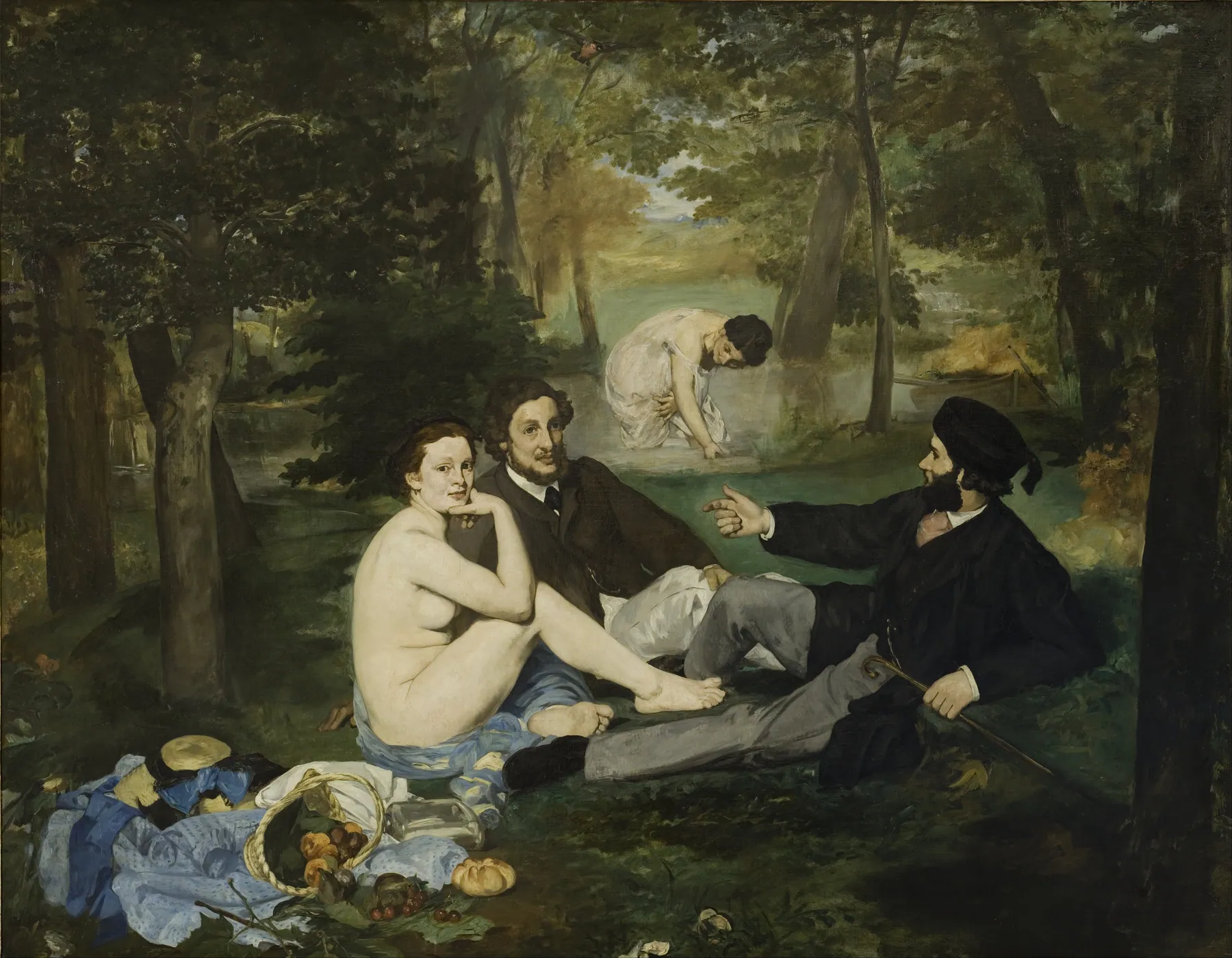
- Édouard Manet
- Date
- 1863
- Medium
- Oil on canvas
- Dimensions
- 208 × 264,5 cm
- Collection
- Musée d'Orsay, París
- Print up to
- 70 × 100 cm
- Reference
- XDV-4412
What the museum label doesn't tell you
She isn't looking at the men beside her. She's looking at you. That's the real provocation here, more than the nudity itself. Manet borrowed the figures' arrangement from a Renaissance engraving after Raphael — a perfectly respectable classical alibi — but stripped his model of the demure, downcast gaze the genre demanded. The 1863 jury didn't reject a nude body. It rejected a naked woman who wasn't asking permission to be seen. What happens when the subject stares back?